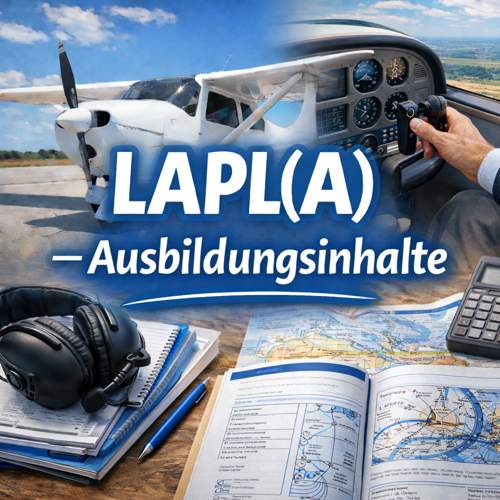
LAPL(A) – Educational Content Explained Compactly
The training is composed of theoretical and practical teaching units. The aim is to provide prospective pilots with the knowledge and flying skills to be safe and responsible in visual flight (VFR).
The theoretical part covers, among other things, aviation law, navigation, meteorology, aerodynamics, human performance as well as technology and aircraft science. These basics are crucial for making flight decisions correctly.
Practical instruction includes numerous flight hours with experienced flight instructors, training take-off and landing techniques, emergency procedures, navigation and safe handling of the aircraft.
Theoretical training
| Theoretical subject matter | Contents |
|---|---|
| Aircraft law | Flight rules, licences, responsibilities, airspace structure |
| Aircraft General Knowledge | Aircraft engineering, systems, instruments |
| Flight performance & Flight planning | Weight calculation, performance data, route planning |
| Human performance | Physiology, perception, stress management |
| Meteorology | Weather phenomena, flight weather interpretation, weather influences |
| Navigation | Maps, course calculation, radio navigation aids |
| Operational procedures | Standard procedures, radio operation, safety |
| Basics of flying | Aerodynamics, flight behaviour, control effects |
Practical training
| Practical part | Scope / Content |
|---|---|
| Initial training | Control, take-off, landing, circling |
| Single flights (solo) | At least 6 hours solo incl. Single cross-country flight (minimum 80 km) |
| Cross-country flight training | Navigation, radio navigation, airspace training |
| Emergency & Security exercises | Disconnection, engine failure, emergency landings |
| Flight preparation & Flight planning | Weather check, fuel calculation, weight calculation |
| Final flight test (skill test) | With an examiner, under real flight conditions |