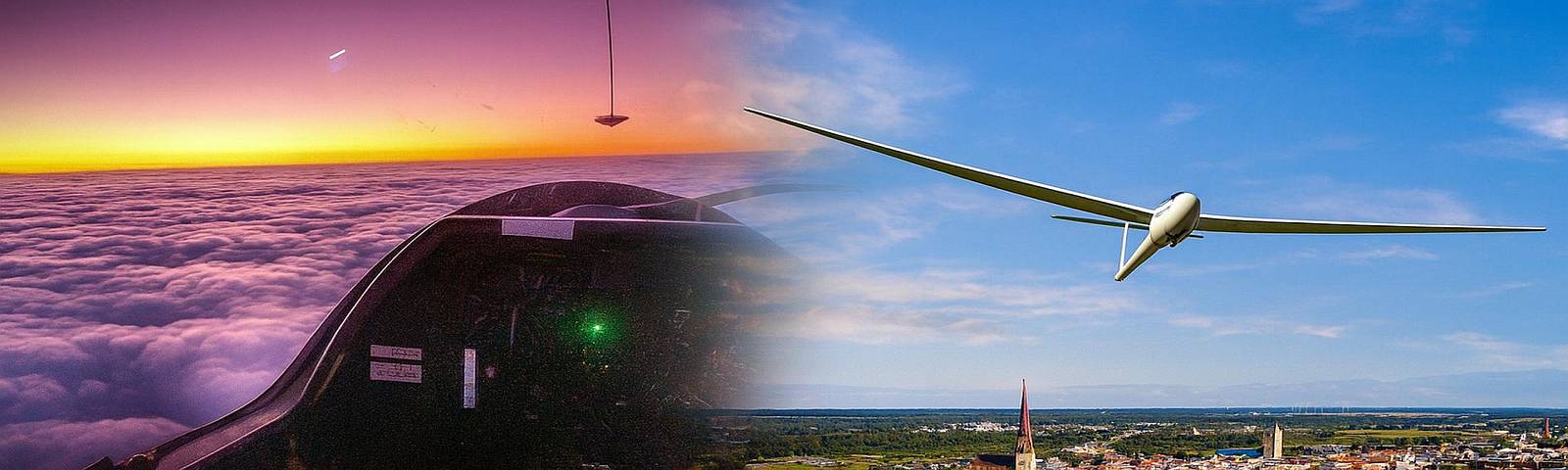
Gliding – training content and process
Sailplane Pilot Licence (SPL) training consists of three areas:
-
Theoretical training
-
Practical or Flight training
-
Examinations (theoretical and practical)
Depending on the flight school or club, the duration may vary, typically it is one to two years, depending on weather, personal learning time and flight frequency.
Training content at a glance
| Training area | Content | Objective |
|---|---|---|
| Theoretical training | Air Law, Navigation, Meteorology, Human Performance, Aircraft knowledge, operational procedures, communications |
Providing all knowledge for safe flight decisions |
| Initial training | initial dual take-offs and landings, straight ahead, cornering; Circulars |
Control of base manoeuvres |
| Advanced flights | Thermal, fast, slow, spinning (Recognize/Avoid), Outside Landing Preparation |
Further development of aviation skills and flight tactics |
| Single flights (solo) | First solo circling, construction flights, line preparation | Proof that the student pilot can safely lead the aircraft alone |
| Line flying training | First cross-country flights, navigation, outdoor landing training, use of the Thermics over longer distances |
Preparation for solo cross-country flight to test maturity |
| Radio instruction (optional) | BZF I/II (if student pilot wishes to obtain a radio certificate) | Participation in radiotelephony with ground or aeronautical stations |
| Theoretical examination | Multiple-choice questions for all fields of theory | Demonstration of theoretical knowledge |
| Skill test | Dual test flight/examiner: take-offs, landings, emergency procedures; Thermics, navigation |
License maturity in practical flying |
Theoretical training in detail
Theoretical training often takes place in the winter half-year and covers the following topics:
-
Aircraft law & Requirements: Rights, obligations, traffic rules
-
Aircraft General KnowledgeConstruction, instrumentation, aerodynamics
-
Meteorology: Thermal, cloud, weather maps, wind systems
-
NavigationCourse calculation, map reading, airspace structures
-
Human performancePerception, stress limits, safety
-
Operational proceduresFlight planning, checklists, emergency procedures
Practice – the way from the first start to the solo
Practical training begins in a double-seater with a flight instructor. Typical steps:
-
First basic flights
-
Flying stable courses
-
First thermal flights
-
Emergency procedures and safety manoeuvres
-
Release for solo flight (solo)
-
Prerequisite: aviation safety, stable landings, safe decision-making
-
-
Solo superstructure flights
-
Cross-country training
-
At least one cross-country flight over the required distance (e.g. 50 km Solo
-
Examinations and licences
At the end, two examinations are required:
-
Theoretical examination at the Authority
-
Skill test with a recognised examiner
Upon successful completion, the student pilot will receive the SPL (Sailplane Pilot Licence).