ATPL (H) – Information about training
Training content of the helicopter ATPL licence
The training content of the ATPL(H) covers all theoretical and practical areas required for professional use as a helicopter pilot. The theoretical part comprises 14 subjects, including navigation, meteorology, flight planning, aviation law, flight performance and human performance. Particularly challenging are subjects such as instrument flight procedures or aerodynamics especially for rotorcraft, as they require a deep understanding of complex control mechanics.
The practical part consists of several hundred flight hours – depending on previous experience and training path between 135 and 200 hours or more. This includes basic maneuvers such as take-off, hovering, autorotation and emergency procedures, as well as advanced techniques for commercial operations. One focus is on instrument flight, which enables pilots to navigate safely even in poor visibility conditions.
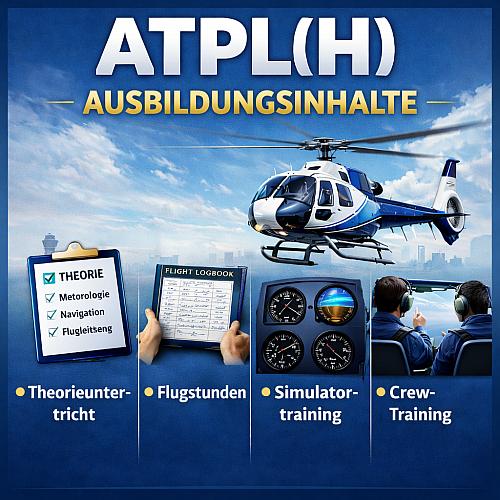
In addition, modern simulators are used to train emergencies, IFR procedures and complex scenarios realistically. The handling of navigation systems, cockpit management and crew cooperation (CRM) plays an increasingly important role.
Overall, the ATPL(H) training provides a comprehensive qualification that goes far beyond pure flying. It prepares aspiring pilots to make complex decisions, take responsibility for passengers and materials, and navigate a wide range of operational environments.
Duration and course of training
The duration of ATPL(H) training depends heavily on the training model, flight school and personal availability. Full-time programs usually last 18 to 30 months, while modular programs – where individual licensing levels are completed consecutively – can take between two and four years.
At the beginning is usually the theoretical ATPL training, which can take place either in face-to-face lessons or as a distance course with face-to-face phases. This section shall include intensive learning phases and periodic mid-term examinations before the official examinations are taken with the competent authority.
In parallel or afterwards, the practical flight modules follow. This includes basic VFR training, navigation, emergency procedures and later IFR training. Simulator phases complement practical training and enable realistic exercises that would not be feasible in actual flight or only to a limited extent.
Finally, a skill test will be conducted consisting of different sectors, simulated emergencies and navigation tasks. After successful completion of all parts, the applicant can apply for the ATPL(H) license – one of the highest qualifications in international aviation.