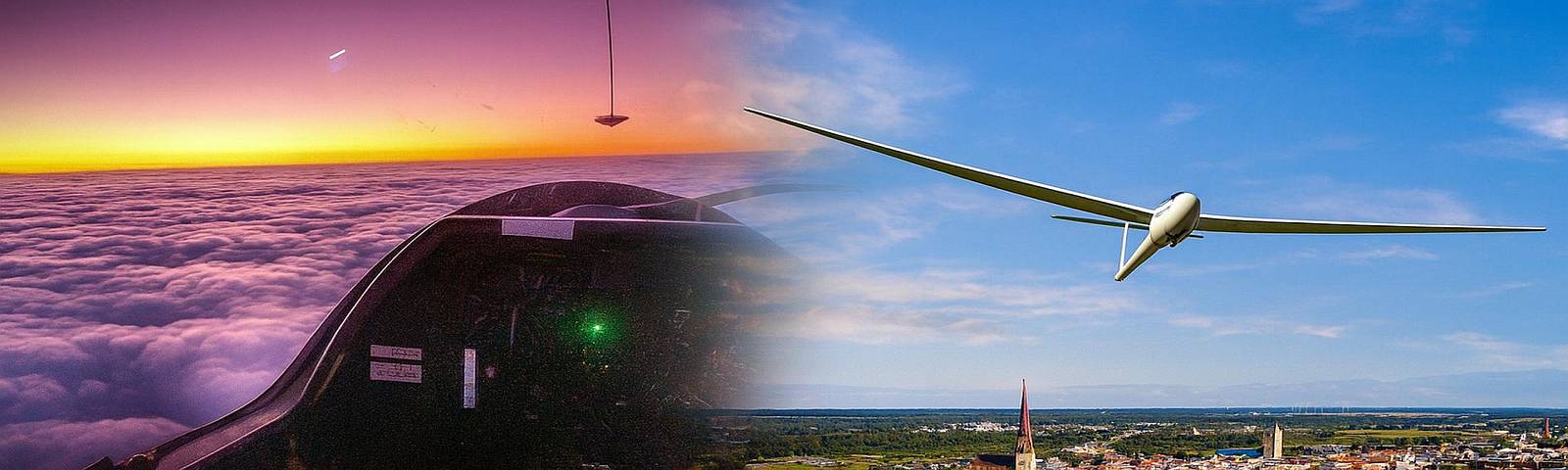
Straight flight
Straight ahead flight is one of the basic flight attitudes in glider flight and forms the basis for all other flight maneuvers. Only those who can fly their glider clean, coordinated and calmly straight ahead are able to safely execute turns, climbing, landing approach and thermal flight. The aim of the straight-ahead flight is to keep speed, altitude and course constant at the same time without creating unnecessary rudder deflections or flight conditions such as sliding or pushing.
In training, the straight-ahead flight serves to develop a feeling for the effect of the individual control elements, to learn the correct gaze guidance and to trim the aircraft correctly. In this way, he trains not only motor skills, but also aerial foresight and the clean coordination of all control movements.
Eye guidance
Guidance is crucial for a quiet straight-ahead flight. The eye is turned Primarily outside, where Horizon and landscape serve as a reference for location and course.
The instruments will only Short and regular inspections, in particular:
-
the Traction indicators for speed monitoring;
-
that: Variometers for the control of climbs or sinks,
-
they are: Slip skid (slip skid) to verify coordination.
Those who mainly look at the instruments tend to flight uneasy.
Maintaining speed
The speed is through Minimum pitching movements set. Larger rashes or pumps shall be avoided.
A correctly set Trimming It is essential that:
-
The billet should Pressure-free be:
-
The aircraft is largely Flying straight by itself.
Keeping the course and the situation stable
The wings will be parallel to the horizon held. Small slants are Immediately and with low rudder deflections balancing.
The rudder is consistently used, otherwise:
-
Slipping is created (ball outside),
-
or Pushing (Bullet inside).
A cleanly coordinated straight-ahead flight is characterized by a quiet location, central ball and minimal steering movements.
🕹️ Control – who does what?
Note set: Height – Area – Foot
-
Elevator rudder
The rules govern the Speed -
Cross rudders
And they keep them. Wing horizontal -
Side rudders
→ Takes care of Coordinated flight
👉 Small, quiet corrections – not after-tax
Eye guidance
👁️ Primarily look outside
-
horizon & Landscape as a reference
📟 Checking instruments only briefly
-
Traction indicators
-
Variometers
-
Slip skid (slip skid)
👉 Too much instrument vision = Troubled flight