Sail flying training
Gliding training leads to the SPL(S) – Sailplane Pilot Licence. It shall consist of practical training, theory lessons, radio-telephony certificates and medical certificates. Your way is usually via the aviation sports club, because there the training is the most favorable.
The Gliding training content are clearly structured and build on each other systematically. In practical training, flight students first learn the basics of flight control, starting modes such as Winches– and F tow start and safe landing techniques. With increasing experience come Thermal flight, cornering, emergency procedures and cross-country flights. A special focus is on decision-making in the air and the safe assessment of weather and terrain situations.
The theoretical part of the gliding training content includes subjects such as aerodynamics, meteorology, aviation law, navigation, engineering and human performance. The training is complemented by the acquisition of the radio-telephone certificate, which provides correct and safe radio communications. All training content is designed to prepare pilots for independent flight operations in a practical, safety-oriented and compliant manner.
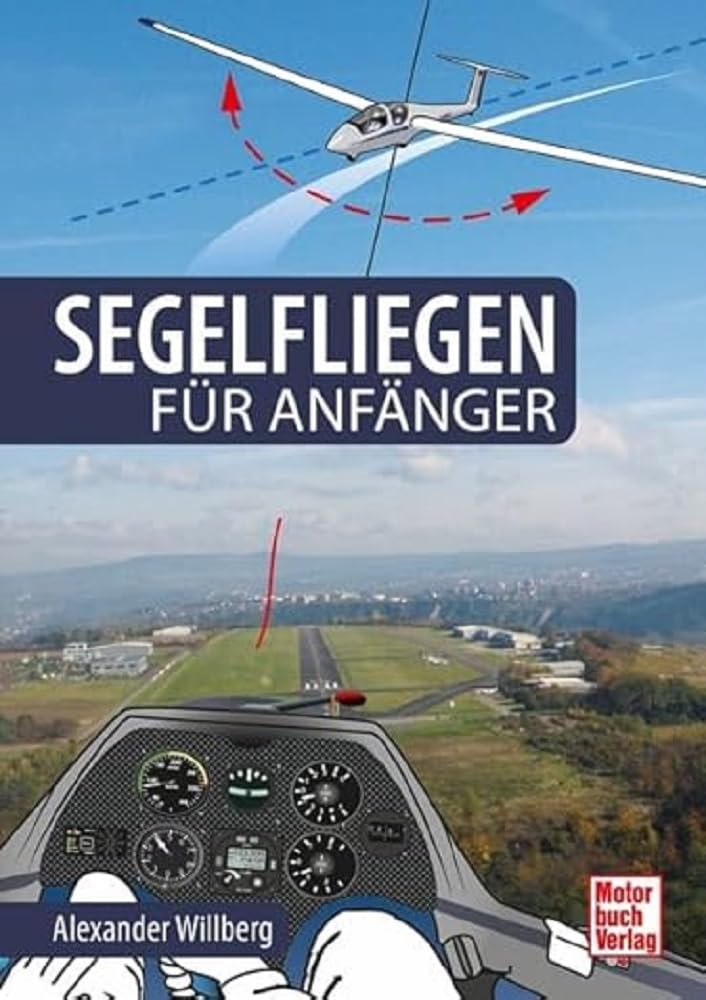
Recommended book*
Overview table: gliding training from A to Z
| Range | Contents / Requirements | Typical scope | Notes |
|---|---|---|---|
| Requirements | Minimum age 14 (single flights), licence from 16 | — | Consent of parents <18 |
| Medicine (Class 2) | Flight suitability examination | 30–120 min | Validity 5 years ()<40 J., otherwise shorter |
| Theoretical training | Air Law, Meteorology, Navigation, Engineering, Conduct in Special Cases | 60–80 hours | Can take place at the club or online |
| Radio Certificate (BZF I/II) | Duty for controlled airspace | 20-30 hours | Examination at the Federal Network Agency |
| Practical training | Take-off technique, circling, thermals, external landings | Approximately 60-120 starts | Varies greatly per student |
| Sole phase | 3 solo flights to receive | 3–10 hours | Depending on the ability & Association |
| Cross-country | 50 km solo flight OR 100 km with dual flight | 1–3 flights | Obligation for the licence |
| Skill test | 3 Flights with Examiner | 20-40 minutes per flight | Start, thermals, emergency procedures |
| Costs | Association training, fees, medical examinations | 1,000–3,000 € in association | Private flight schools up to 7,000–10,000 € |
Course of practical training
1️⃣ Basic training
-
Dual control in the training double-seater (ASK 13, ASK 21, Puchacz, etc.)
-
Take-off modes: Winds (often), F-towing (Sometimes)
-
Objectives: Straight flight, curves, landings, thermal approaches
2️ Solo flights
-
When you land safely and control the plane
-
At least 3 lap solo
3️⃣ Advanced training
-
Thermal flight
-
Slow-flight, circular aerial technology
-
Emergency procedures (e.g. Cable crack on the winch
-
Outside landing training
4️ Overland flight
-
Navigation
-
Weather assessment
-
Obligation:
-
50 km away solo or
-
100 km with flight instructor
-
5️⃣ Exam
-
3 Flights with Examiner
-
Contents: Start, thermal, curves, slip, security, landing
Theory: What You Really Need to Be Able to Do
Examination subjects
-
Aircraft law
-
Aircraft General Knowledge
-
Flight performance & Flight planning
-
Meteorology
-
Navigation
-
Human performance
-
Conduct in special cases
Test: Multiple choice, about 60-100 questions depending on the state authority.
Licence & Rights
-
SPL(S) – Sailplane Pilot Licence
You may:
-
Driving sailplanes
-
Flying TMG (motor gliders) after additional training
-
Passengers (after 10 flight hours after obtaining the license)
Validity
-
Unlimited validity
-
only medical & The proficiency check shall be up-to-date.
-
Radio Certificate (BZF)
-
BZF II for German-speaking radio (sufficient for gliding)
-
CZF I for English radio, useful for cross-border routes
-
Component: voice groups, position messages, taxiing and departure clearances